RMS and Effective Value Thought
Due to the unusual humidity, me and my friends decided to visit the beach. We swam for some time. Then we sat down on the beach to relax. Slowly, a sense of peace came over me. I sat there listening to the wind. I watched the sea waves come in and go back, again and again, in the same pattern.
Watching those waves, my mind slowly drifted to another wave. It was one I had studied many times in books: the sine wave of AC current. The sea was rising and falling continuously. That sine wave also rises and falls on paper, in the same way. That’s when an old question came back to my mind — one I never fully understood in class:
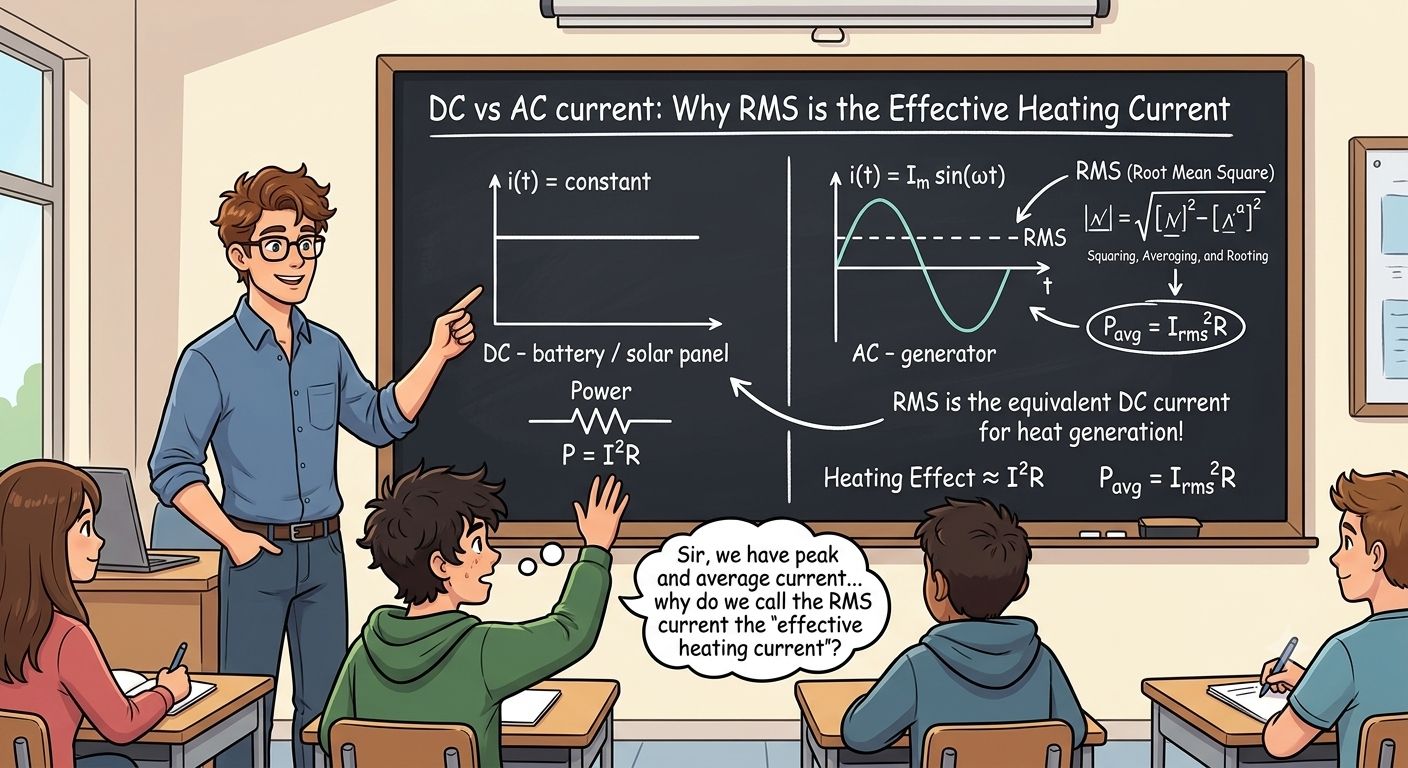
Why do we call the RMS value of AC the “effective” or “heating” current?
So I decided to explore this properly, and cover every part of it in this post — the RMS value definition, the RMS value formula, and how it applies to a plain sine wave, a half wave rectifier, and a full wave rectifier.
This is written for beginners, step by step, with nothing skipped.
Before We Start: Remember These Two Simple Things
What is AC and DC current? and What is sine wave?
Yeah, this basic fundamental concept is enough to understand the whole concept. So let’s begin.
What is AC and DC current?
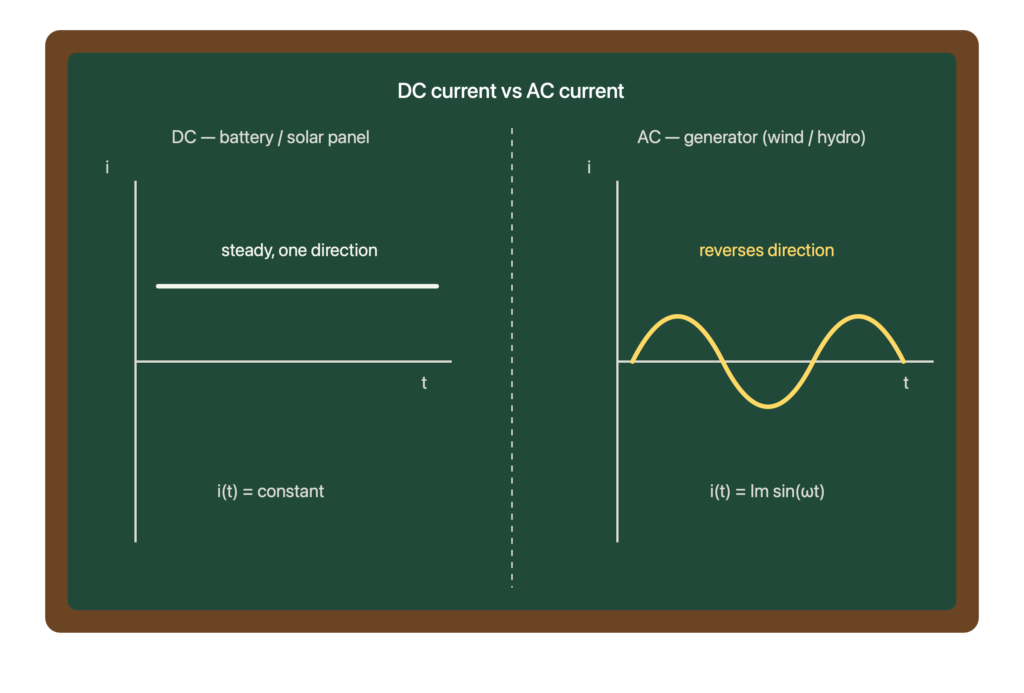
AC current comes from a generating plant, where electrons keep moving back and forth instead of flowing in one steady direction. This continuous back-and-forth movement, measured over current and time, is exactly what creates the sine wave shape.
The current starts at zero, rises to a peak, comes back down to zero, then goes below zero to a negative peak, and returns to zero again. This pattern repeats continuously — and that repeating up-down-up-down motion is what we call a sine wave.
Note: Many textbooks commonly simplify by saying “electrons move back and forth,” so this works fine for a beginner-level explanation. Technically, the alternating voltage from the generator drives the current to reverse direction — you can mention this briefly if you want to reach slightly more advanced readers.
DC current comes from sources like batteries and solar panels, where the current flows steadily in one direction.
What is a Sine wave?
If you draw AC current on a graph (current on Y-axis, time on X-axis), it looks like a SINE wave. It goes up to a peak, comes down, goes below zero, then comes back up. This shape repeats continuously. Please refer below image:

It is written as:
i(t) = Im sin(ωt)Here:
i(t)= Current at any given timeIm= Maximum (peak) value of currentω= (angular frequency) How fast the wave repeatst= Time
Don’t worry if this formula looks complex right now — we will use it step by step below. However you remember this
So, what’s the real problem of this AC current?
Let’s dig into a bit of history.
In the late 1800s, engineers faced a real challenge during the famous “War of Currents” between Thomas Edison’s DC systems and the AC systems championed by Nikola Tesla and George Westinghouse. As AC power spread across cities, engineers needed a reliable way to rate AC equipment — the same way people already rated DC devices using a simple, constant current value.
But AC current doesn’t behave like DC; it constantly changes direction and magnitude. This forced electrical engineers to develop a new measurement method that could fairly represent AC’s real-world effect — and that method became the RMS value we use today.
Then, why zero?
This is the most important starting point. Many students get confused here, so let’s go slowly.
Now lets consider, you are trying to find the average of one full AC cycle, what you will get? you get zero.
Why? For half the cycle, current is positive. For the other half, current is negative — it reverses direction. Positive and negative values cancel each other out when you average them.
Average of one full sine wave cycle = 0
But here is the problem: we know for a fact that AC does produce heat just like DC does. Your iron box, heater, and bulb all get hot using AC current. So if the average is zero, how do we measure the “real effect” of AC?
This is exactly why engineers needed a different way to measure AC. Not a simple average — something that reflects the actual heating effect. That method became the RMS value we still use today.
The Solution: Using Heat as the Reference Point
Here’s the trick that solves the whole problem. Engineers used the heating effect as the reference point for measuring RMS value of current.
When current passes through a resistor (like a heater coil), the heat produced depends on this formula:
P = i² RWhere:
P= power (heat produced)i= currentR= resistance
Look closely at this formula. It squares the current (i²) instead of using it directly.
Why does squaring matter?
Because when you square a negative number, it becomes positive.
Example:
(+5)² = 25
(-5)² = 25
Same result! This means: even during the negative half of the AC cycle, the circuit still produces heat — and that heat is still positive.
So the current averages to zero over one cycle. But the current squared — and therefore the heat — never becomes zero. This is the key reason RMS uses squares. It’s where “Squaring” in Root Mean Square comes from.
Step-by-Step: RMS Value Formula for a Sine Wave
Now let’s calculate the RMS value of a sine wave properly, one step at a time.
Step 1: Start with the current equation
i(t) = Im sin(ωt)Step 2: Square it (this is the “Square” in RMS)
i²(t) = Im² sin²(ωt)Step 3: Find the average (mean) over one full cycle (this is the “Mean” in RMS)
This step needs one small fact from trigonometry, which you can simply remember as a rule:
Average of sin²(ωt) over one full cycle = 1/2So:
Average of i²(t) = Im² × (1/2)
                           = Im²/2
Step 4: Take the square root of that average
(this is the “Root” in RMS)
Irms = √(Im²/2)

Irms = Im/√2
Final RMS Value formula
Irms = Im/√2 ≈ 0.707 × ImIn simple words: the RMS value of AC current is about 70.7% of its peak value.
The three steps above — Square, Mean, Root — literally give RMS its name.
Now Let’s Prove Why We Call It “Effective” or “Heating” Current
This is the goal of this whole post — connecting RMS to the real heating effect.
Heat produced by AC current (average, over one cycle):
P(AC average) = Irms² × RHeat produced by a steady DC current “I” of the same value:
P(DC) = I² × RThe real question we’re answering is: what value of steady DC current produces the exact same heat as our AC current?
To find this, set both powers equal:
I² R = Irms² RCancel R from both sides (since R is same on both sides):
I² = Irms²

I = Irms
What this proves:
A DC current equal to the RMS value of an AC current will produce exactly the same amount of heat. This happens in the same resistor, over the same time.
This is exactly why we call RMS the:
- Effective value — because it is the value that is “effective” at producing heat.
- Heating current — because it directly represents heating capacity, matching an equivalent DC current.
Simple Real-Life Example
Let’s say a manufacturer rates a heater at 10A RMS AC current.
This means: if you replace this AC supply with a steady 10A DC current, the heater will produce the same amount of heat in both cases.
This is a very powerful idea. It lets us compare AC and DC using one common number, even though AC keeps changing and DC stays constant.
Why This Matters for You as a Student
- When your multimeter shows AC voltage or current, it is always showing the RMS value, not the peak value.
- Manufacturers give all electrical appliance ratings (fan, bulb, heater, motor) in RMS, because that tells you the actual heating/working effect.
- In exams, a question about “the current” in an AC circuit almost always means RMS value — unless it says “peak” or “maximum.”
Quick Summary Table
| Term | Value | Meaning |
|---|---|---|
| Peak current (Im) | Maximum value | Highest point of the wave |
| Average current (1 full cycle) | 0 | Positive and negative halves cancel |
| RMS current — sine wave | Im/√2 ≈ 0.707 Im | Equivalent DC value for same heating |
| RMS current — half wave rectifier | Im/2 | Only half the cycle conducts |
| RMS current — full wave rectifier | Im/√2 ≈ 0.707 Im | Entire cycle contributes, same as sine wave |
RMS Value Definition in Electrical Terms
In simple electrical terms: the RMS value of an alternating quantity (current or voltage) is the equivalent steady DC value that would produce the same amount of heat in the same resistance, over the same amount of time. It’s called “root mean square” because of exactly how it’s calculated — square the values, take their mean (average), then take the square root of that average.
Final Understanding, in One Line
We call RMS current the “effective” or “heating” current because a DC current of that same value produces exactly the same heat as the AC current, even though the AC current keeps changing direction and magnitude the whole time.
That’s the full answer. Next time you’re at the beach watching the waves rise and fall, you’ll know exactly why they reminded me of this topic.