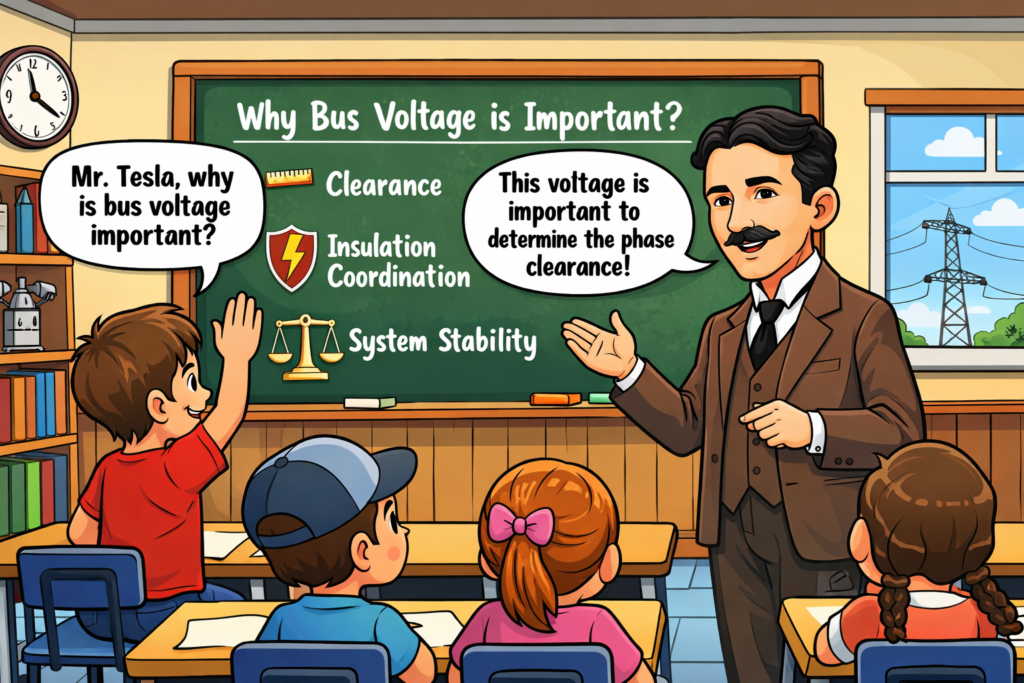
When discussing bus voltage, many people confuse it with rated voltage. Since electrical equipment is designed for a specific rated voltage, and the nameplate also indicates a fixed rated value. This often leads to the incorrect assumption that the rated voltage is the actual bus voltage.
As an electrical engineer, you must understand that while they are related, they are not the same.
Rated voltage is a fixed design parameter used for engineering specifications, whereas bus voltage is the actual, fluctuating voltage present on a bus, varying based on system conditions.
Does Bus Voltage Matter for Design?
You might wonder: “Does bus voltage concept really matter if it doesn’t show up in the formulas for sizing the conductor metal?”
Yes,it is important, While current determines the size of the copper or aluminum bar, the bus voltage is the primary factor in determining the follwing parameters:
- Phase-to-Phase and Phase-to-Ground Clearances: The air gap required to prevent arcing.
- Insulation Coordination: The type and size of insulators required to support the bus.
- System Stability: How much power the system can safely transmit.
The above concepts are very big concepts. I try to cover it in separate blog.
What is a “Bus” in a Power System?
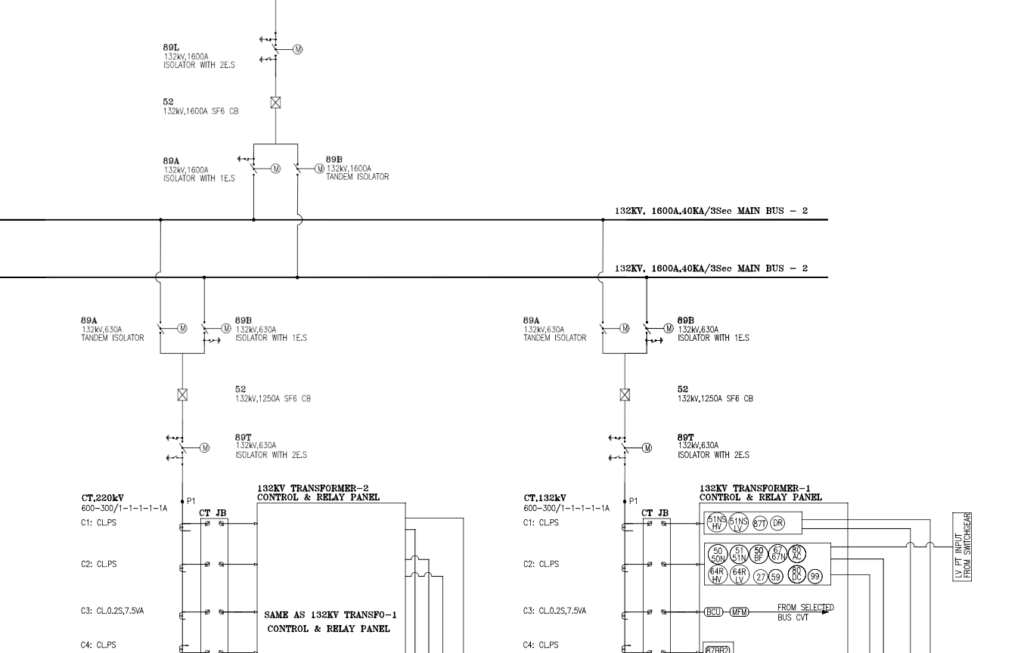
You think of a bus not as a vehicle, but as a distribution hub. Physically, it is a static, structural conductor (a busbar) that carries electric current between different electrical equipment/elements like transformers, generators, and OHL/UGC feeders.
- The Mathematical View: In circuit analysis, a bus is treated as a node—a single point where Kirchhoff’s Current Law (KCL) is applied.
- The Physical View: A busbar is a common connection point made of copper (Cu) or aluminum (Al). Its physical size depends on current-carrying capacity, but its spacing depends on voltage/emf.
Defining Bus Voltage Conditions
Bus voltage is the actual operating voltage or electromotive force (EMF) measured on the busbar at any given moment. It is a dynamic value that can fall into three categories:
- Rated Voltage: The “Safe Zone.” This is the voltage level at which the busbar is designed to operate continuously and safely for its entire lifespan. It dictates the insulation levels and creepage distances.
- Overvoltage (ANSI Code 59): Occurs when the voltage exceeds the safe limit, often due to lightning strikes, switching transients, or sudden loss of load.
- Undervoltage (ANSI Code 27): Occurs when the voltage drops below the functional range, usually due to heavy loading or system faults.
Overall, I understand that bus voltage is the generalized term and core idea is simple.
Why bus voltage linked to phase clearance?
Ok, now to understand why we need to care about bus voltage, we must look at how it affects the entire system design—from phase spacing (clearance) to the stability of power flow.
Lets assume the bus bar experience the short-circuit force due to fault current(Ish), now this short circuit force generates numerous amount of magnetic field arround the bus bar and it will turn the conductor into powerful magnet. In a three phase system, where the bus bar runs parallel to each other, these magnetic field interect and exert a force that tries to bend the bars. .
Same Direction: If the short-circuit current flows in the same direction in two bars, the magnetic force pulls them together.
Opposite Direction: If the currents flow in opposite directions, the force pushes them apart
During a fault, the short-circuit current can be 20 to 40 times higher than normal operating levels. In power engineering, the force (F) is proportional to the square of the current (I^2). Therefore, even a small increase in fault current leads to a massive increase in the mechanical force exerted on the busbar.
How fault current (Ish) linked to bus voltage?
When the fault current creates a massive magnetic force on the busbar, the bus voltage to this fault current helps us to decide the intial distance between the busbars that is called clearance. If the voltage is higher, the bars are placed further apart, which actually helps to reduce the total magnetic force they exert on one another.
The bus voltage determines the minimum air gap between the phases (R, Y, B) and grounding structures.
In physics, the magnetic force (F) between two parallel busbars is inversely proportional to the distance (d) between them.
F ≈ d/I^2
Because higher Bus Voltages require significantly higher Phase Clearances to prevent electrical arcing, the bars are naturally placed much further apart.
Why bus voltage linked to insulatation co-ordination?
In busbar sytem, the insulators are very critical to isolate the electrical conductivity bar from the structures, particularly during the arcing conditions. To avoid any unintentional flow of fault current to the structure.
The busvoltage helps to determine the height and type of insulators used. Higher voltage requires taller insulators to prevent “creepage” (electricity traveling along the surface). However, a taller insulator acts like a longer lever. When the Fault Current creates that magnetic force at the top of a longer insulator, it creates a huge bending moment at the base.
As an engineer, it is his responsibility to calculate the bus voltage to set the height, and then calculate the fault current to ensure that the insulators are not damaged short circuit.
Power System Impedance
Finally, there is a mathematical link. The magnitude of the Fault Current (Ish) is determined by the system voltage divided by the impedance (Z):
Ish=V/z
If the Bus Voltage is maintained at a high level, we can often transmit the same amount of power with less current.
Lower operating current means we can sometimes use smaller conductors, but we must never forget that the Fault Current—and the forces it brings—is what truly tests the physical strength of the design.