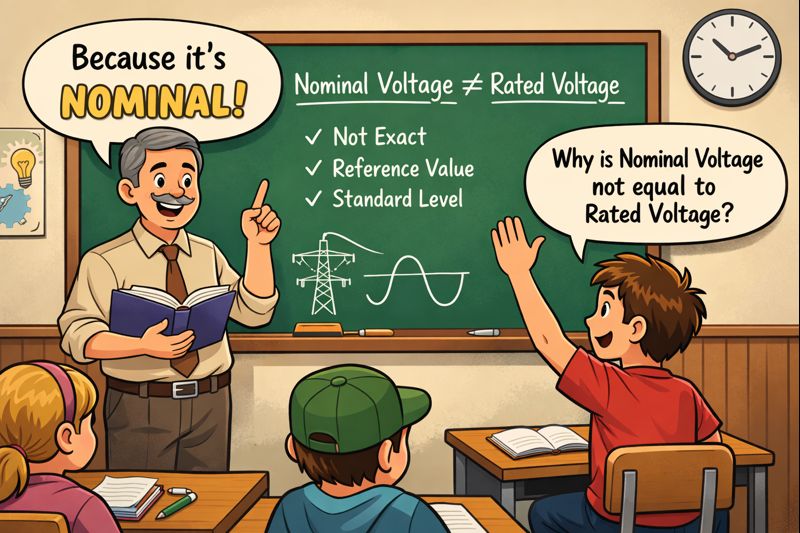
While I was revising an electrical technical standard, I came across the term “Nominal Voltage“. My initial thoughts was simple: it just refers to a normal reference voltage used to denote the voltage level of transmission and distribution substation (Power system/network), as well as auxiliary voltage AC and DC systems thats all.
Then I had one big doubt:-?
If manufacturers design their equipment to rated voltage, why is a nominal voltage required at all?
Is nominal voltage really important? why power system and network using this nominal voltage.
Nominal Voltage in real power system
For example in India, transmission lines carry high voltages such as 132 kV, 220 kV, 400 kV, or 765 kV. These values are treated as standard nominal voltage, and distribution substations voltage levels decided base on them.
Hence, all substations are referred to by their nominal voltage or reference voltage.
As per PGCIL, a 765kV digital substation is located at Navsari in Gujarat. Even here, the voltage level is represented using the nominal voltage, not the actual operating voltage or rated voltage that may vary in real time.
At the same time, the manufacturers take this nominal voltage as a reference point and design their electrical equipment around it with an appropriate rated voltage. Hence we can call Nominal voltage as pre-determined voltage.
For example, the table below shows the rated voltage corresponding to each nominal voltage in India
| Nominal system voltage in kV (For substation rating) | Rated system voltage in kV (For equipment rating) |
| 765 | 800 |
| 400 | 420 |
| 220 | 245 |
| 132 | 145 |
| 33 | 36 |
But why does this difference exist?
Understanding the Word “Nominal”
In search of an answer, I dug deep into the history of word “nominal”.
The word nominal is derived from Latin word “nominalis” commonly known to mean “name” only.
Nominal is an adjective word used to describe a value assigned for identification and reference. I understand that it does not necessarily represent real value.
This raised another question in my mind?
If nominal voltage is just a “name,” then is there no technical concept behind it? Is nominal voltage meant only for non-technical people?–Overthinking continues on
A Lesson from History (Why Nominal Values Exist)
While searching the answer for these questions, I came across the rich history behind this.
The concept of nominal value did not originated in electrical engineering. As explained before, the latin word “nominalis” entered the English language in the 15th century through traders, manufacturers and popularised to describe, the quantities that vary in real time.
In earlier days it was very difficult to measure quantities that fluctuated in real time.
For example, even if a horse can run at a maximum speed of 71kM/hr, it could not maintain the same speed under all environment conditions. Its actual speed would vary depending on the horse’s energy, health and surrounding.
So, when selling a horse, it was necessary to assign a nominal value to represent its speed- a reference point that did not try to chase the minimum or maximum power, but instead gave a standardized idea of its capability. Hence, sellers might assign, a nominal running speed typically 40km/hr. This value did not showcase the exact speed at all time; its served only as a reference for identification and comparison.
Did you Know?
Large companies listed on the stock market use the term “nominal value” in their balance sheets. In finance, the nominal value (also called face value) represents the assigned value of a share for identification and legal purposes, and it does not necessarily reflect the market value of the share.
At this point, I had some clarity.
How “Nominal value” Entered Power Systems
During the development of electrical power system in the 19th Century, the engineers faced the major problem in measuring the real time electrical quantities such as potential difference (voltage), electric charges (current) using reliable meters.
In the early days of electrical distribution, Thomas Edison (Dc systems) used the first practical meters to measure charges over time. These measurements assumed a nearly constant supply voltage.
For example, if consumer used 200Ah at a constant 200V, the electrical power consumption can be calculated based on this reference voltage. This principle later evolved based on into clock-dial type meters.
From history we can understand that, the engineers relied on reference (nominal) voltage levels to standardise measurements, billing, and system design.
Is nominal system voltage a non-technical concept?
Nominal Voltage was not born purely from theory, but from the limitations of early measurement technology
When I asked the manufacturers directly, I realised that there is no single fixed answer and it depends on the lens through which you view the concept.
From a manufacturer’s point of view, I clearly understand that it is highly technical and essential. Manufacturers require a standard reference or nominal voltage to design their electrical equipment that can safely withstand the maximum rated voltage and operate reliably within defined system limits.
While reviewing the nameplates of electrical equipment such as power transformer, GIS, surge arrestor, for a 320kV substation, I commonly observed a rated voltage of 420kV. This confirmed that manufacturers do not design electrical equipment to operate only at the nominal voltage, but to safely withstand higher rated voltages based on system requirements.
Conclusion on nominal voltage
From my understanding, experience and through my personal lens, I can confidently say that nominal voltage is not a non-technical concept. Although it may appear simple in first thought, it plays important technical role in electrical equipment design, insulation co-ordination, and overall power system reliability.
When you look deeper into how manufacturers design and rate electrical equipment, you will clearly see that nominal voltage serves as the foundation upon which rated voltage and system limits are defined. So, while nominal voltage may sound like ‘just a name,’ you and I now know that it is a key engineering reference that keeps power system on.
Electrical Sensei Insight

Nominal voltage was born not from theory, but from the limitations of early measurement technology.